The name of the restaurant - Noblesse - is engraved in the window that separates the outcast women from the diners who excised them. The French word means what it looks like, but is perhaps more widely know as in the phrase "Noblesse oblige" - a concept which implies that those with wealth or prestige have a heightened social accountability. Or to quote Spiderman, "with great power comes great responsibility."
Director W.I.Z. has previously tackled issues of class and discrimination, but here his commentary is laced with a hint of modern political allegory. The privileged patrons of the glossy establishment observe the members of the bachelorette-party with condescending smirks and glances. Eventually they set the two groups of rowdy drunk women against each other, observing the ensuing brawl with glee - simultaneously sharing knowing looks (as if to say "I told you they were uncivilized") while quietly relishing in the spectacle of the physical altercation. The lower "class" fights amongst itself while the upper, protected by the institutions of society, stands back and watches with a sense of moral superiority - a pattern which could apply to a certain war in the Middle East, or recent riots on the streets of Paris.
Yet it's the restaurant itself which got half these ladies drunk in the first place. And while they may pretend to be above the crowd, the seated folks have the same human desires and emotions as the skirt-lifting women they shun. While one group expresses their sexuality with blow-up sex toys and racy lingerie, the other resorts to secretive touching under the table. The wine-n-dine crew resent the scantily-clad and loud women across the restaurant precisely because they expose the suppressiveness of their own stuffy mentality. They stand in the window and relish the altercation out there because it releases all the emotion they hold back in the name of everything that is "proper."
It's only a matter of time before the mob realize they are being used. And when that happens they will do as they've been trained to do: express their anger through base violence. Sadly only in these moments when the fear comes home do the wealthy and powerful truly understand their social obligations - and hopefully the ersatz nature of "nobility."
There is an ongoing debate in the UK over so-called "anti-social youth" who are identified by their penchant for wearing "hoodies." Many public places, such as shopping centers and pubs, have banned hooded customers from entering their establishments. The case is made that gang-bangers and criminally minded kids prefer hoods, primarily because they conceal faces and make it harder for witnesses to identify them later. But most adolescents argue that "hoodies" are simply comfortable and fashionable attire, and that it's unfair to punish the whole for the actions of a few. Thus the "hoodie" has become a symbol of the cultural divide between the older and younger citizens of England.
W.I.Z.'s music video for Dizzee Rascal's "Sirens" is loaded with vibrant imagery, but one of its most quietly potent ideas centers around Dizzee's choice of attire. The hooded jacket he wears (and is forced to remove) is about more than a conflict between young and old though, it's the fear of the unknown itself. It's about those in power being afraid of "difference," of what they don't understand and can't see. And it's about exploiting those in a weaker position without concern for the long-term effects it has on society at-large.
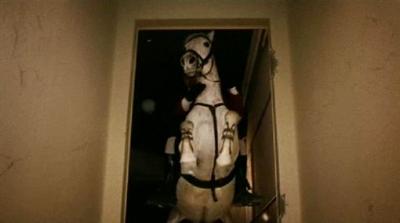
Then of course there is the monumental foxhunt, which heightens the power of the video with piercing surrealistic metaphors. The uniform of choice for these men and women is the same tight red coats hunters in England have been wearing for centuries, an equally loaded symbol of status and class. These "sportsmen" break down Dizzee's door as he casually works on music with his brother (or son). Remember that the video begins with peaceful silence, there is no sign of any "anti-social" youth out for havoc in the night until the hunters lure the "fox" out of its hole.
W.I.Z. constructs every frame with an obsessive attention to detail. Dizzee walks by a wall spray-painted "only cowards steal from the poor." Later the galloping horses pass a yellow sign that reads "Smile! You're on CCTV" - implicating the government in this witch hunt. And when Dizzee reaches out to a woman for help, she turns him away while we notice a "Neighborhood Watch" sticker on her window. The look in her eyes is an assumption of guilt - a hooded black man turns up at her window asking for help (even if she knows who he is) and she has no intention of letting him in.
Race is of course a major factor in this equation. What is really hidden under that hood is Dizzee's black skin, his dark unknown face. When he removes his coat the director cuts to a shot of a women sensually admiring his body, and it isn't just about the sexualization of the black man's physical form. It's the power gained from reducing a human to a literal slab of meat - the thrill of seeing your intense fear thrown out in the open, vulnerable and weak. A type of blood lust.
It was common practice to rub the blood of the captured fox on the cheeks and forehead of the newest member of the hunt. Thus the cycle of discrimination and class mentality is easily passed along to the next generation. Yet on the other side Dizzee's young friend also witnesses the absurdity of the scene, and is now destined to be one of those "anti-social" youths. Dizzee is paranoid about "the sirens coming" precisely because he knows he is a target of law enforcement by default, the hood is almost a necessity.
But this cycle of fear and difference originates in higher and older places than the London city police. The young lady who receives the celebratory blood on her face is wearing a necklace with a small gold replica of the Queen's crown. Foxhunting itself is believed to be an off-shoot of the "royal" game of stag-hunting, which the Queen herself still plays to this day (thanks for that Helen Mirren). What greater symbol of the continued influence of class divisions on British society than the still (uselessly) present Royal Family?
On one of the horses that chase the black Dizzee Rascal down the street, W.I.Z. zooms in on a bundle of rope hanging from the white rider's saddle. We may not want to remember what upper class fear of difference and exploitation of the weak has led to in the past, but it's no coincidence the head of a foxhunting group carries the chilling title of "master." It's the most subtle and daring statement in a video chock full of them.
As Lisa Lindley-Jones stands somberly in a nearby alley, holding a bright flare and only partially obscured by shadow, her police officer pursuer walks by without even a glance in her direction. The two are so close at this moment that it seems nearly impossible that he wouldn't notice her, but it appears to be the case nevertheless. Yet perhaps he doesn't really want to catch her. And even if much of the video implies that she may actually want to be caught, here she makes no move to alert him of her presence either. Is she saddened by his lack of perception? Or is the thought of capture suddenly unpleasant and scary?
Early in the video the duo seem to just barely miss each other, and at times it appears as if she is indeed after him as much as he seeks her. They crawl along the same wall, open the same doors and cross each other's shadows - but always a step behind or in the wrong direction. As Lindley-Jones runs forward, the officer literally runs backward (a stunning visual). She hides in spots that his flashlight finds, and he seems far too tentative in his hunt to be entirely sure he wants to make an arrest.
Lindley-Jones spends a lot of time running away and hiding, but if her actual intention is escape, she isn't very good at it. In one particularly memorable scene she is seen sprinting while looking back in laughter, her dress flowing in the wind and her smile illuminating the black and white tones of the shot. She carries her torch as if to keep the officer in pursuit, while it also protrudes like a weapon meant to scare him off.
The director uses a silent film style which recalls early Maya Deren and abstract film. Like those pre-talkie movies, which many consider the finest ever made, the strength of the piece relies on the power of the images to relay information. The surreal quality of the classic herky-jerky camera cuts adds a layer of mystery (and fear) which proves to be highly relevant to the themes of the work. At the same time this is a music video, which means it has the added assistance of the song and its lyrics to provide clarity.
It begins with a backwards "Fin," which is something different than the opposite of the end. It implies a strange conclusion, or a lack of real resolution. The opening of the jacket leading into the beginning of the narrative mirrors the "step back" theme of the song. Lindley-Jones walks into the frame as if she is retracing alleyways in her memory. The rooms he inspects are in fact part of a museum, with her human form standing in the corner as a marble reminder of what was. But the final movement is a regression down the alley, and underlines the inconclusive nature of the memory.
In many ways the two slowly move away from the statuesque hesitancy of those early encounters along the walls, towards a more playful open interaction. She skips along the side of the building and he begins to run feverishly - even falling at one point. The tension is mounted in this way, so that we are in constant anticipation of their meeting up and till the point where they nonchalantly pass each other.
So why didn't this work out? What is it that eventually prevents something from happening between the two? We've suggested it is the fear of commitment and expressing one's feelings which hinders the couple, but there are deeper levels to the psychologies of these characters. At one point the woman is juxtaposed with an image of flying birds, and her movements suggests an inherent need for escape and free expression. The officer on the other hand is decked in the stifling uniform of the law enforcement, holding a mechanical flashlight while she carries the more dangerous fire. The building itself almost looks like a prison with it's meager windows under the moonlight.
Yet human beings, and especially in terms of their sexual and emotional make-up, are far too complex to be labeled as having only one particular type of desire or urge. The woman rings a bell in the middle of the video, as if calling her mate to dinner, and exerts a certain amount of control over the situation herself. Simone De Beauvoir argued that we all seek to be both the object and the subject in matters of the heart. The problem may be that the man is unable to let down his guard in the same way, he is consistently presenting an image of power and enforcement. It creates an aura of fear which plays with the Gothic sensibility of the camera work, and puts a wall between the two. She often looks despairingly at him as she stands motionless for him to grab - his inability to catch her creates doubt in her own mind.
We fear taking that next step, even if it is the step we've hunted for so long. We also simply love playing the game - almost more than we love winning. The chase is a thrilling experience, even if it fails to fulfill. Lindley-Jones and her director highlight the subtle eroticism of the mating dance - "oceans flow" around the sun and hands caress stone walls. The tragedy is perhaps that there must be an end, whether positive or negative. Despite the joys of love there is something to be said for the unique pleasures of flirting - the anticipation of love. Yet we seek more, and that's why each time we revisit these memories, no matter how high the peaks, we still end up feeling dissatisfied.




![[search archives]](http://www.google.com/custom?domains=obtusity.blogspot.com&q=archives&sitesearch=obtusity.blogspot.com&sa=Search&client=pub-0935254757130455&forid=1&ie=ISO-8859-1&oe=ISO-8859-1&cof=GALT:%23008000;GL:1;DIV:%23336699;VLC:663399;AH:center;BGC:FFFFFF;LBGC:336699;ALC:0000FF;LC:0000FF;T:000000;GFNT:0000FF;GIMP:0000FF;LH:50;LW:252;L:http://img301.imageshack.us/img301/4703/background5copypo6.jpg;S:http://www.obtusity.com;FORID:1&hl=en)